
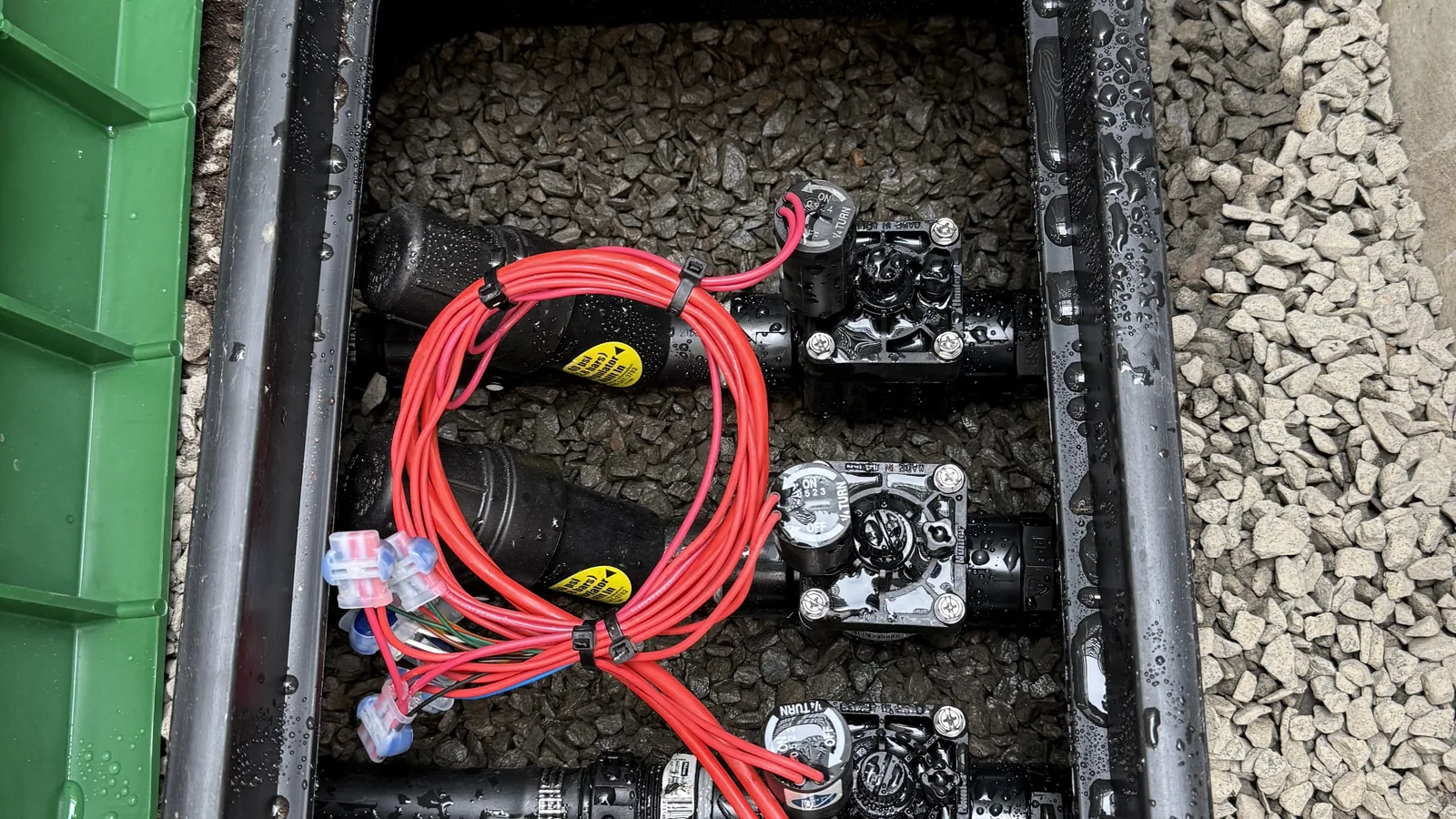
A wet valve box, repeated fitting failures or several unreliable irrigation zones can indicate a problem with the valve manifold rather than one isolated component. The important question is whether the fault can be repaired locally or whether the manifold has reached the point where rebuilding it will provide a more dependable result.
That decision should be based on the condition of the full assembly—not simply the first leaking fitting or failed valve that can be seen. A local repair can be practical when the surrounding pipework and valves remain sound. Where fittings are brittle, access is poor or previous repairs have created a patchwork arrangement, replacing another single component may only postpone the next failure.
What the valve manifold does
An irrigation valve manifold distributes water from the supply line to individual irrigation zones. It typically includes several solenoid valves, tees or other connecting fittings, pipe connections and low-voltage control wiring within or beside a valve box.
Each valve controls a separate zone, such as turf sprayheads, garden dripline or another landscaped area. When the controller activates a station, it sends power to the appropriate solenoid. The valve opens and directs water into that zone's lateral pipework. When the signal stops, the valve should close and hold back the pressurised water supply.
Because several hydraulic and electrical components are concentrated in one location, a manifold fault can affect more than one zone. It can also create symptoms that appear to come from the controller, field wiring, sprayheads or underground pipework.
Confirming whether the manifold is the source
Water visible inside a valve box does not automatically prove that the manifold is leaking. Water can travel through soil from damaged pipework elsewhere, enter from surface drainage or remain after a zone has operated. The first step is to observe when the water appears and test the system under controlled operating conditions.
A leak that continues while every irrigation zone is off may be on the constantly pressurised supply side of the manifold, around a valve body or bonnet, or at an upstream fitting. Water that appears only when one station operates may be escaping from that valve's outlet connection or from the lateral pipework serving the zone.
Similarly, a zone that does not start is not necessarily evidence of a failed valve. The cause may be a controller output fault, damaged field cable, a poor common-wire connection, a failed solenoid or an internal valve problem. A zone that continues running can result from debris beneath the diaphragm, a damaged diaphragm, an open manual bleed, incorrect solenoid operation or an electrical control fault.
Targeted irrigation fault finding helps separate these possibilities before parts are replaced or the valve box is excavated further.
When a local manifold repair is appropriate
A complete rebuild is not always necessary. A focused repair may be the sensible option when testing identifies one localised problem and the remainder of the assembly is in good condition.
Examples include:
one cracked or leaking fitting with sound pipework around it;
a failed solenoid on an otherwise serviceable valve;
a worn or damaged diaphragm that can be replaced;
a damaged waterproof cable connection at one valve;
one valve that can be replaced without disturbing brittle adjoining fittings; or
a minor pipe connection failure where there is enough space to complete a reliable repair.
The surrounding condition matters. Repairing one fitting is unlikely to provide lasting value if the adjacent components are already stressed, badly aligned or deteriorating. Enough working room is also required to prepare pipework correctly and reconnect the assembly without forcing components into position.
When rebuilding the manifold is the better decision
Rebuilding becomes more appropriate when the problem involves the overall condition or arrangement of the manifold, rather than one clearly isolated component.
Common reasons include:
several valves or fittings leaking or failing;
brittle, cracked or badly misaligned pipework;
repeated patches that leave little sound pipe available for another repair;
mixed or incompatible components from earlier alterations;
valves installed too closely together to service properly;
a valve box that is damaged, undersized or positioned too low;
poor access to solenoids, flow controls or manual bleed points;
unidentified zones and disorganised field wiring; or
a history of repeated call-outs for faults in the same assembly.
In these situations, replacing one more fitting can cost less initially but leave the property exposed to another failure. A planned rebuild can improve reliability, make future servicing easier and provide a clearer arrangement for identifying valves and zones.
The decision is not based on age alone. An older manifold that remains accessible, dry and mechanically sound may only need a local repair. A newer assembly may require rebuilding if it has been poorly supported, incorrectly arranged or damaged by ground movement, roots, vehicles or nearby construction work.
What should be considered before rebuilding
A manifold rebuild needs more planning than replacing parts in the same position. The existing layout should first be documented so that each valve, control wire and downstream zone can be identified before anything is disconnected.
Access and valve-box layout
Valves need enough space for testing, solenoid replacement and future servicing. Where site conditions permit, a larger or better-positioned valve box may provide more practical access than returning the rebuilt assembly to an overcrowded space.
The finished box should not place unnecessary strain on pipe connections or leave electrical joins buried beneath the manifold. Raising or repositioning a box may help reduce soil entry and surface-water intrusion, but drainage and surrounding ground levels must still be considered.
Compatible components and water source
Replacement valves, fittings and pipe connections must suit the system pressure, pipe material and intended application. The water source also matters. Systems supplied by tanks or pumps may have different flow, pressure, filtration and water-quality conditions from a standard mains-water system. Valve selection and filtration should reflect those conditions rather than simply copying the previous components.
Isolation and future servicing
Where practical, the layout should allow the manifold to be isolated and serviced without unnecessary disruption to unrelated irrigation sections. The available water supply arrangement, existing isolation points and site constraints will determine what is achievable.
Clear valve and zone identification is equally important, particularly on strata and commercial properties with multiple controllers or manifold locations. Labels and updated zone records can save considerable time during future fault finding.
Wiring and waterproof connections
Manifold rebuilding often involves disconnecting and renewing valve wiring. Each solenoid requires a reliable station conductor and common-wire connection back to the controller. Cable joins inside valve boxes should be made with suitable waterproof connectors and positioned so they remain accessible.
If testing indicates that the fault lies beyond the manifold, irrigation wire fault detection may be required before healthy valves are replaced unnecessarily.
What a dependable repair or rebuild should include
The exact work depends on the site, but a methodical process should include:
Isolating the water supply and confirming the system is no longer pressurised.
Identifying and recording existing valves, zones and control wiring.
Testing to confirm which components have failed and which can remain.
Removing damaged sections without unnecessarily disturbing sound pipework.
Installing compatible, pressure-rated valves and fittings in the correct flow direction.
Renewing damaged solenoids or waterproof cable connections where required.
Supporting and positioning the assembly so pipework is not left under strain.
Testing for leaks under static pressure and while each affected zone operates.
Confirming that every valve opens and closes correctly from the controller.
Checking the downstream zones for pressure, coverage or delivery problems that may have been hidden by the original fault.
Turning the water back on is not the end of the job. A fitting may remain dry under static pressure but leak when a valve operates, and a new valve can work manually while an unresolved field-wiring fault prevents controller operation. Final zone-by-zone testing is what confirms that the full repair is working as intended.
Manifold repairs on strata and commercial properties
On managed properties, repeated manifold failures can affect common-area presentation, water use and maintenance planning. Wet paths, continuously running zones or failed irrigation in high-visibility areas may also generate complaints and urgent call-outs.
Where several components are deteriorating, a documented rebuild can be easier to approve and manage than a series of unrelated repairs. The repair scope can identify which faults require immediate attention, which components will be retained and how the revised layout will improve access or reliability.
This does not mean every older manifold should be replaced. It means the repair decision should consider the cost and disruption of repeated failures, not only the price of today's leaking fitting.
Repair the actual fault—not the first visible symptom
An irrigation manifold sits at the centre of the system's water distribution and valve control. When it fails, the visible result may be a wet valve box, a dry zone, reduced pressure or a controller fault. Those symptoms need to be traced back to their actual cause.
Smit Irrigation & Landscaping provides solenoid valve repairs in Sydney, manifold fault finding and irrigation leak detection for residential, strata and commercial systems. The aim is to determine whether a reliable local repair is possible or whether rebuilding the manifold will provide better long-term value.
If your valve box is leaking, several zones have become unreliable or the same manifold has been repaired repeatedly, contact Smit Irrigation & Landscaping to arrange an assessment.