
Hunter WVL for Hard-to-Reach Irrigation Valves
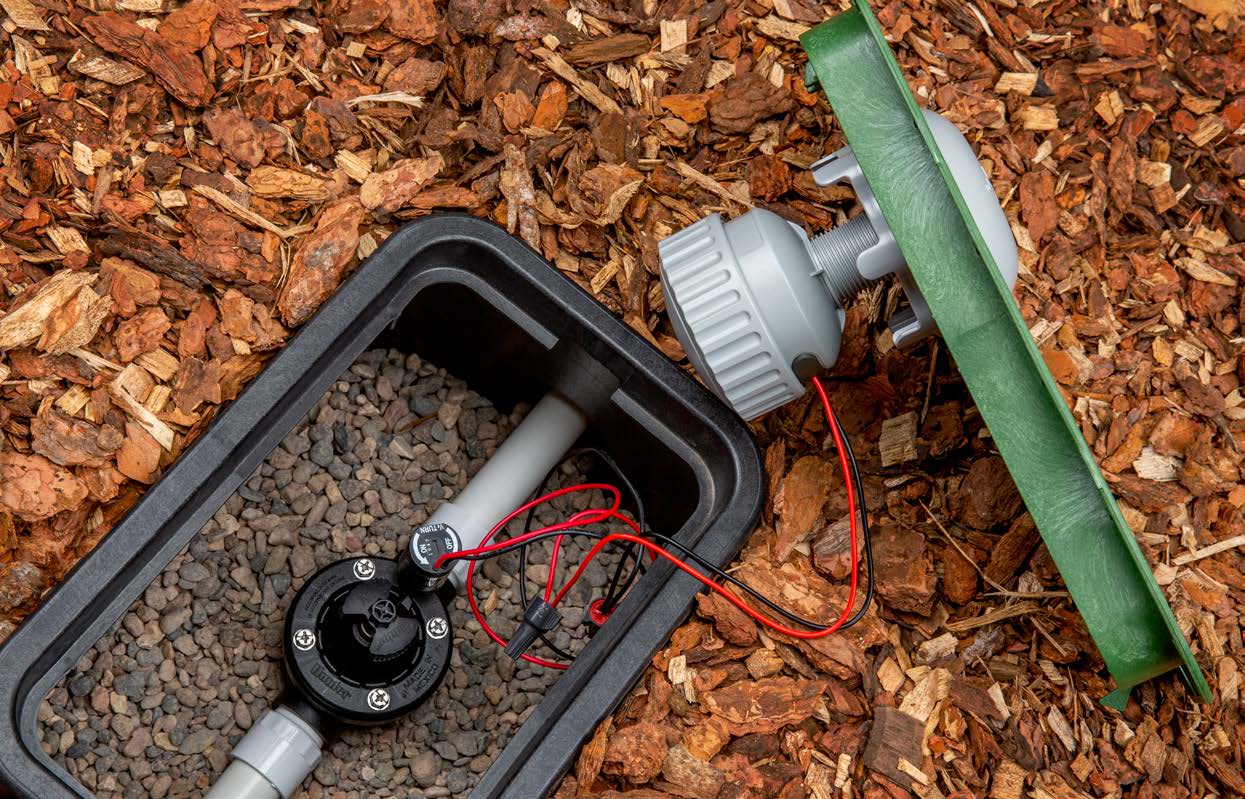
Photo courtesy of Hunter Industries Incorporated.
Adding irrigation to an established garden can be straightforward until the new control cable needs to cross a driveway, paved courtyard or finished landscape. The valve may have a suitable water supply nearby, but connecting it to the controller can involve disruptive excavation.
Hunter Wireless Valve Link, usually called WVL, offers an option for carrying the control signal wirelessly to a remote valve location. For Sydney homes, strata properties and commercial sites, it may make an irrigation extension practical where a conventional cable route is difficult.
What Hunter WVL does
WVL links a compatible irrigation controller to equipment at the valve using radio communication. A wireless output module at the controller communicates with the field unit, which connects locally to suitable valve solenoids.
The wireless link carries the control signal. The valve still needs a water supply and pipework to the area being irrigated. The proposed layout therefore needs both a workable control arrangement and adequate water delivery.
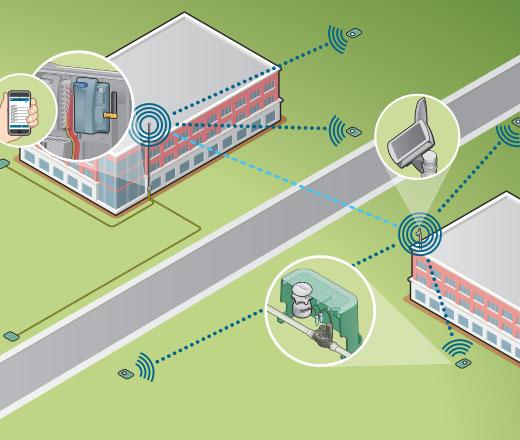
Photo courtesy of Hunter Industries Incorporated.
Where wireless valve control can help
One potential application is a planting bed on the far side of a paved accessway. If water is already available there, wireless control may avoid a new cable crossing through the finished surface.
It can also be considered when extending an existing system into a separate garden area, or where damaged field wiring is difficult to replace without disturbing established landscaping.
These are examples of where the product may suit the site. The decision should follow an inspection of the existing system, the cable route and the proposed valve location.
Two proposed irrigation upgrades by Smit Irrigation
The following concepts show how wireless valve control can be planned for different properties. Both are proposals, with the final layouts and equipment requirements subject to verification on site.
Concept 1 — central control across a large property
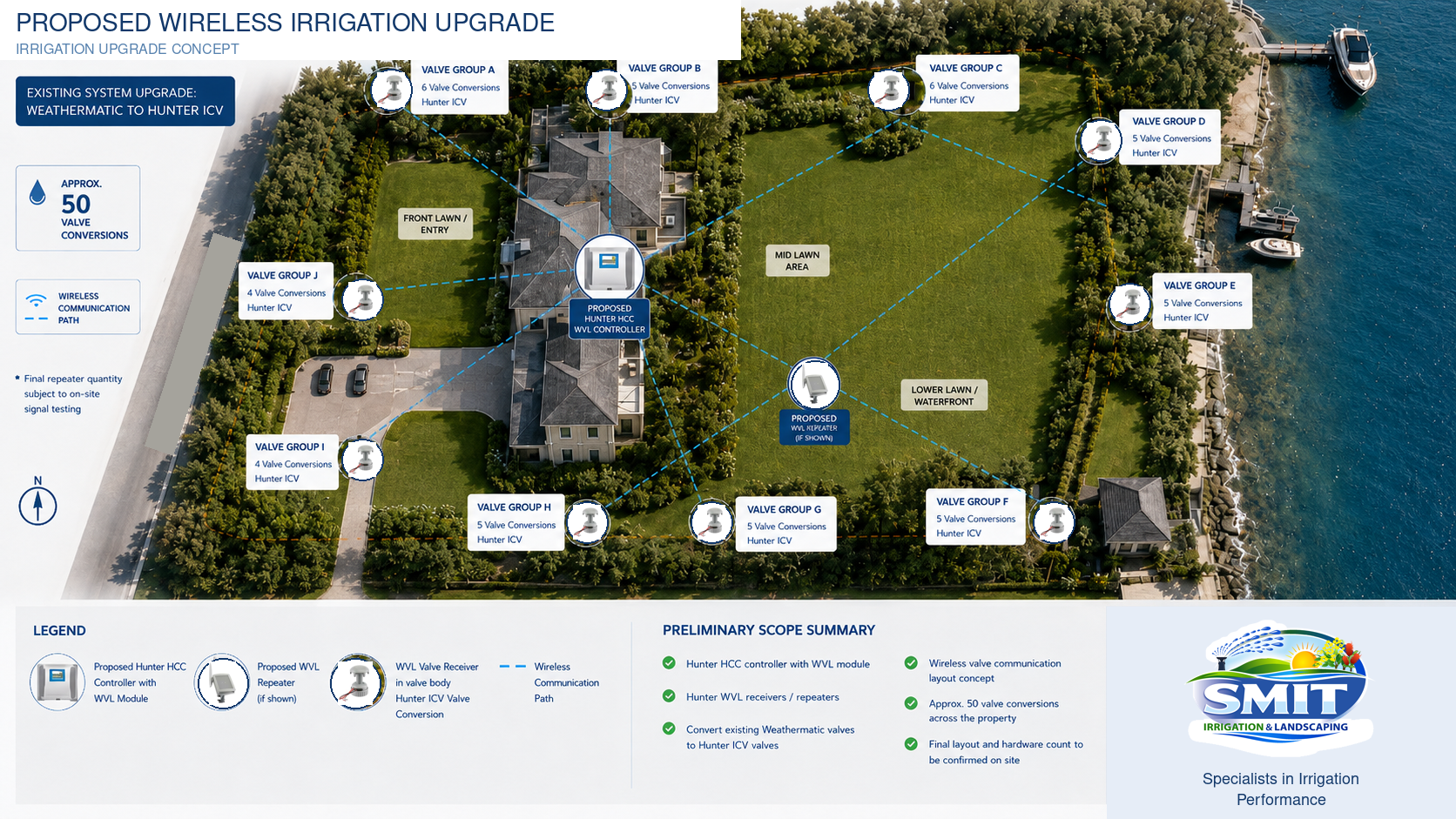
The larger-property proposal considers replacing an existing Weathermatic field-control arrangement with Hunter HCC control, Hydrawise access and distributed WVL receivers for approximately 50 valves. Hunter ICV valves with DC-latching solenoids are proposed, subject to confirming valve sizes and condition.
The objective is to bring the valve groups under one central control system while reducing reliance on ageing field wiring. A repeater is allowed for if required, with its need and position to be confirmed through an on-site wireless signal test.
Concept 2 — bringing separate battery timers under central control
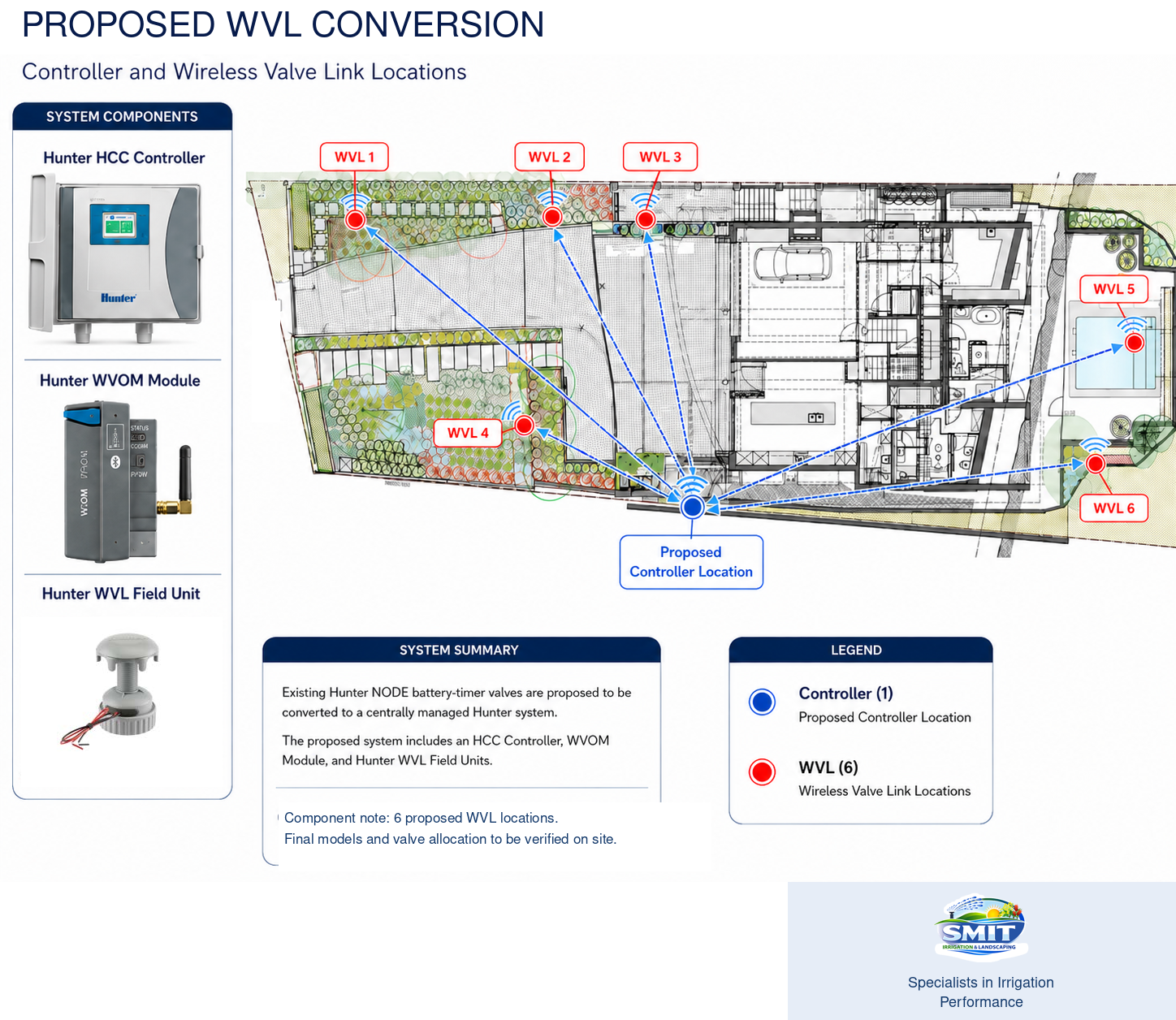
The central-control concept proposes converting existing Hunter NODE battery-timer valves to a centrally managed system. The layout indicates one Hunter HCC controller, a wireless output module and six WVL field locations around the property.
This illustrates a different use for wireless valve control: bringing separate valve locations into a common control arrangement. The indicated wireless paths are conceptual, and final unit selection, valve assignments and signal coverage need field verification.
For both proposals, commissioning would need to confirm communication, correct station assignment, valve activation and shut-off, and water delivery through each irrigation zone.
Check the controller and valve equipment first
Hunter’s current product information lists HCC, ICC2 and MCC controller compatibility. WVL is not a universal accessory for every Hunter timer or every Wi-Fi controller. The controller model and required output module must be checked before selecting equipment.
The field units use suitable DC-latching solenoids. Existing valve equipment needs assessment for compatibility and condition. Correct local wiring and protected connections remain part of the installation.
Test communication at the actual valve location
Distance alone does not establish whether a wireless installation will work. Buildings, terrain and foliage can affect communication. Hunter provides a site-survey function so coverage can be checked before installation.
The controller location, antenna arrangement and proposed field position should be assessed together. Where needed, an appropriate repeater arrangement may be considered. Site testing should guide the design rather than assuming a quoted maximum range will apply through every obstruction.
Read the Hunter Wireless Valve Link brochure (PDF)
Keep maintenance access practical
WVL field units are battery powered, with a solar charging option available. The equipment and valve box should remain accessible for inspection and servicing.
For strata and commercial sites, record the controller model, station assignments and valve locations. Clear records make it easier for the next person maintaining the system to identify which equipment controls each area.
Investigate an existing fault before upgrading
A failed irrigation zone can result from a controller problem, damaged cable, poor connection, solenoid fault or mechanical valve issue. Wireless control is worth considering when the cable connection is the problem, but a valve or water-delivery fault may need a separate repair.
An irrigation inspection can assess the existing system and identify whether cable repair, wireless control or another change is appropriate.
After installation, the system should be tested through complete watering cycles. Check that the intended zone starts, the valve closes correctly and the irrigation outlets deliver water to the required area.
Discuss your irrigation extension with Bazil
Smit Irrigation can assess your existing system and discuss practical options for extending or repairing it. When you speak with Bazil, let him know if a new cable route would cross paving or disturb an established garden.
Photos of the controller, valve location and the area between them will help explain the site. Contact Bazil at Smit Irrigation to discuss an irrigation assessment and a solution suited to your property.